
Personal loan markets in 2026 reflect a split between traditional banking stability and the aggressive expansion of fintech credit scoring. For professionals with stable incomes and high credit marks, borrowing costs have stabilized, though regional variations remain sharp due to local central bank policies.
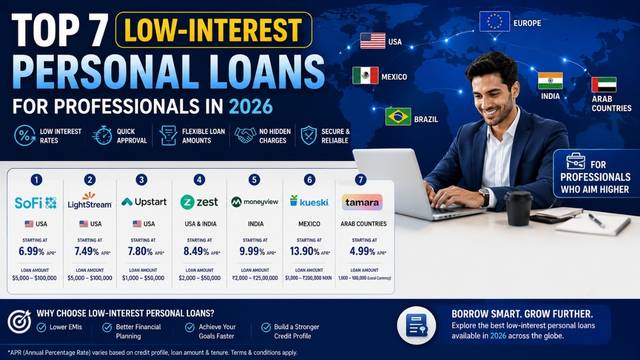
Finding the lowest rates requires looking beyond standard retail banks toward professional-exclusive lenders and digital credit unions.
Regional Interest Rate Benchmarks For Personal Loans(Q2 2026)
| Region | Average Professional Rate (APR) | Primary Market Driver |
| USA | 6.2% – 12.5% | Fed rate stabilization |
| Europe (Eurozone) | 3.5% – 7.8% | ECB liquidity measures |
| India | 10.25% – 14.5% | Credit expansion via UPI-linked lending |
| Arab Countries (GCC) | 4.0% – 6.5% | Fixed-rate structures; Pegged currencies |
| Mexico | 12.0% – 18.0% | High inflation hedging |
| Brazil | 18.0% – 25.0% | SELIC rate influence |
Top 7 Low-Interest Personal Loans for Professionals in 2026
1. LightStream (USA & North America)
LightStream remains a dominant choice for US-based professionals due to its “Rate Beat” program. If you find a lower rate elsewhere, they often undercut it by 0.10 percentage points.
They do not charge origination fees or late payment penalties. For a professional earning over $100,000 with a credit score above 760, rates in 2026 have stayed near the 6.25% mark for home improvements or debt consolidation. The process is entirely digital, and funds are frequently deposited on the same day.
2. Revolut (Europe & Brazil)
Revolut has transitioned from a travel card to a full-scale bank. In Europe, especially in Ireland, France, and Spain, they offer personal loans with near-instant approval based on your spending data.
In Brazil, Revolut has gained traction by offering rates significantly lower than local giants like Itaú or Bradesco. While a traditional Brazilian bank might charge 4% monthly interest, Revolut’s professional tier often drops this to 1.8% – 2.2% monthly (approx. 24% APR), which is considered very low for the Brazilian market.
3. HDFC Bank – Professional Loan Tier (India)
HDFC dominates the Indian market for salaried professionals. Their “Pre-approved” loans for employees of Tier-1 companies (large multinationals and government bodies) are the benchmark for low interest in the region.
In 2026, HDFC offers rates starting at 10.25% for doctors, CAs, and engineers. They often waive processing fees during festive seasons. Unlike fintech startups, HDFC allows for larger ticket sizes up to ₹40 Lakhs ($48,000 USD) without collateral, provided your salary is routed through their accounts.
4. Emirates NBD – Green Loans (Arab Countries/GCC)
In the UAE and Saudi Arabia, Emirates NBD has introduced specialized personal loans for “sustainable” purposes, such as solar installation or electric vehicle upgrades. These carry the lowest interest rates in the GCC, often starting at 3.99% (flat) for UAE nationals and 4.5% for expats.
For general-purpose loans, they rely on “Salary Transfer.” If you transfer your monthly pay to them, the interest rate drops by about 1.5% compared to non-salary transfer loans. In a region where debt is strictly regulated, these loans offer a high degree of transparency with no hidden insurance costs.
5. SoFi (USA)
SoFi focuses on the “HENRY” demographic (High Earner, Not Rich Yet). Their 2026 loan products are designed for professionals looking to consolidate high-interest credit card debt or fund large life events.
The main benefit here is the unemployment protection. If you lose your job, SoFi will temporarily suspend your payments and help you find new employment through their career services. In 2026, their rates for a 3-year term hover around 7.5% for those with excellent credit.
6. BBVA – Consumo Inmediato (Mexico & Spain)
BBVA has the strongest digital lending presence in Mexico. For professionals in Mexico City or Monterrey, the “Préstamo Personal Inmediato” uses an algorithm that analyzes your payroll history to offer a rate lower than the national average.
While Mexico’s base rates are high, BBVA offers “Preferential Rates” to payroll clients that can be 500 basis points lower than their standard offering. In 2026, this translates to roughly 14% APR, compared to the 25-30% often seen in the Mexican retail market.
7. Santander (Europe – UK & Germany)
In the UK and Germany, Santander’s “1|2|3 World” or “Select” customers get access to exclusive loan rates. In 2026, they have prioritized “Socially Responsible Loans.” If the funds are used for home energy efficiency, the APR can be as low as 3.4% in Germany.
For standard cash loans, they offer fixed monthly repayments which is vital in a fluctuating economy. You can borrow up to €30,000 with a five-year term, and the interest remains locked regardless of what the European Central Bank does later in the year.
Comparative Personal Loan Features for 2026
| Lender | Target Profession | Min Credit Score (Equiv) | Max Loan Amount |
| LightStream | Corporate/Homeowners | 740+ | $100,000 |
| Revolut | Tech/Expats | 700+ | €50,000 |
| HDFC Bank | Salaried/CAs/MDs | 750+ | ₹40,00,000 |
| Emirates NBD | GCC Professionals | Salary > AED 15k | AED 500,000 |
| SoFi | Young Professionals | 700+ | $100,000 |
| BBVA | Payroll Employees | Medium-High | $750,000 MXN |
| Santander | EU Residents | High | €35,000 |
Specific Advice for 2026 Personal Loans Borrowers
1. Avoid the “Pre-Approved” Trap
Banks in India and the USA frequently send notifications for “pre-approved” loans. These are often based on a soft credit check and do not always reflect the lowest possible rate. Always click “customize” or speak to a representative to ask for a rate match.
2. Watch the “Personal Loans Processing Fee.“
In Mexico and India, a low interest rate is often offset by a 2% to 3% processing fee. A loan with an 11% interest rate and a 3% fee is more expensive in the first year than a 12% loan with no fee. Always calculate the “Total Cost of Borrowing.”
3. Use the Salary Transfer Leverage
In the Arab countries and parts of Europe, moving your primary checking account to the lender can shave 1% to 2% off your APR. This is a simple administrative move that saves thousands over the life of a loan.
4. The 2026 Tech Advantage
Many lenders now use “Open Banking.” By giving a lender view-only access to your bank transactions for 60 seconds, they can often verify your income and lower your rate because the risk of fraud is reduced. If a lender like Revolut or SoFi asks for this, it usually results in a faster, cheaper loan.
5. Early Repayment Clauses of Personal Loans
Check if you can pay the loan back early without a penalty. In the USA and Europe, this is common. In Brazil and India, some banks still charge a “Foreclosure Fee” of 2% to 4% of the remaining balance. If you expect a year-end bonus, choose a lender that allows fee-free overpayments.
Also Read:- Best Online MBA Colleges in Delhi 2026: Compare Fees & Contact Info