
Personal loans and credit cards serve as the two primary pillars of unsecured debt. When you face a large expense—whether it is a medical emergency in Mumbai, a home renovation in Chicago, or a wedding in Dubai—choosing the wrong instrument can cost you thousands in interest.
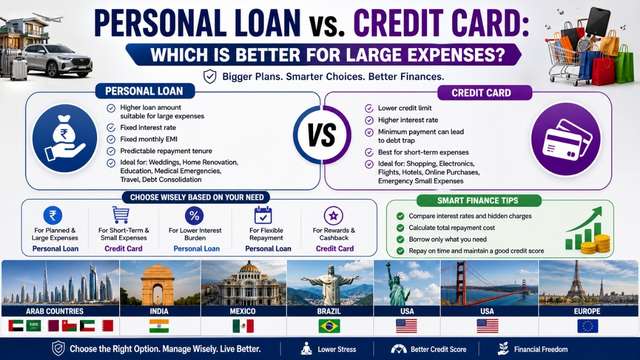
This guide breaks down the mechanics of both options across major global markets to help you decide which fits your specific financial situation.
Personal Loan vs. Credit Card: Which is Better for Large Expenses?
The Core Difference: Structure and Access
A personal loan is a lump-sum disbursement. You receive the full amount upfront and pay it back in fixed monthly installments (EMIs) over a set term, usually one to five years. The interest rate is typically fixed.
A credit card provides a revolving line of credit. You can spend up to your limit, pay it back, and spend again. While convenient, the interest rates are significantly higher than personal loans if you do not clear the balance in full every month.
Regional Market Analysis
Interest rates and consumer behavior vary drastically by geography. Below is a comparison of how these products behave in your specific regions.
| Region | Typical Personal Loan APR | Typical Credit Card APR | Market Nuance |
| USA | 7% – 18% | 20% – 29% | High reliance on FICO scores for pricing. |
| India | 10.5% – 24% | 36% – 48% | Personal loans are often “pre-approved” for salaried apps. |
| Europe (EU) | 3% – 10% | 12% – 22% | Stricter lending caps and lower overall rates. |
| Brazil | 25% – 100%+ | 300% – 400%+ | Extremely high rates; “Parcelado” (interest-free installments) is common. |
| Mexico | 15% – 45% | 40% – 80% | High use of “Meses Sin Intereses” (MSI) on cards. |
| Arab Countries (GCC) | 4% – 12% (Reducing) | 24% – 36% | Many Sharia-compliant “Finance” products instead of “Loans.” |
When a Personal Loan is Better
Personal loans are built for predictability. If you are financing a $15,000 roof repair or a ₹10 Lakh medical procedure, the fixed structure prevents the “debt spiral” often associated with cards.
1. Lower Interest Costs
In almost every country, the interest rate on a personal loan is 50% to 70% lower than a credit card. For example, in the USA, a borrower with good credit might get a loan at 8%, while their credit card sits at 24%. Over three years, that difference represents a massive saving.
2. Fixed Repayment Schedule
With a loan, you know exactly when the debt will be gone. This is vital for long-term budgeting. Credit cards only require a “minimum payment,” which often barely covers the interest, keeping you in debt for decades if you aren’t disciplined.
3. Credit Score Impact
Taking a large personal loan can sometimes help your credit score more than a credit card. If you max out a credit card, your “credit utilization ratio” spikes, which can drop your score. A personal loan is “installment debt,” which is viewed more favorably when managed well.
When a Credit Card is Better
Credit cards are not ideal for long-term debt, but they have specific tactical advantages for large purchases if you have a clear repayment strategy.
1. The 0% Intro APR Window (USA & Europe)
In the US and parts of Europe, many cards offer a 0% introductory APR for 12 to 21 months. If you buy a $5,000 appliance and pay it off within that window, you have effectively received an interest-free loan. No personal loan can beat a 0% rate.
2. Rewards and Consumer Protection
If you have the cash to pay the bill but want to “float” the expense for a month, cards are superior. Purchasing a large item on a premium card in the UAE or India can net you significant travel points or cashback. Furthermore, cards offer “purchase protection” and “extended warranties” that personal loans do not.
3. Installment Plans (Mexico & Brazil)
In Mexico, the “Meses Sin Intereses” (MSI) culture allows you to split a large purchase into 6, 12, or 18 installments at the point of sale with 0% interest. Similarly, Brazil’s “Parcelado” system is a staple. In these markets, the credit card is often the cheapest way to buy electronics or furniture, provided the retailer offers the plan.
Comparison Chart: Large Expense Scenarios ($10,000 / ₹8 Lakh / R$ 50k equivalent)
| Feature | Personal Loan | Credit Card |
| Approval Speed | 1–3 Days (Digital) | Instant (if you have the limit) |
| Interest Type | Fixed | Variable |
| Fees | Processing fees (1–3%) | Annual fees, Late fees |
| Best For | Debt consolidation, Weddings, Home improvement | Emergency repairs, Travel, Tech gadgets |
| Risk | Collateral (rarely), Credit damage | High-interest trap, Compound interest |
Detailed Breakdown by Use Case
1. Home Renovations
Renovations usually involve multiple payments to contractors over several months.
- The Move: Take a personal loan for the bulk of the material costs and labor. Use a credit card only for the finishing touches or decor to earn rewards, then pay the card off using the loan funds or monthly income.
2. Debt Consolidation
If you have multiple small debts across different cards in India or the USA, the interest is likely bleeding your monthly budget.
- The Move: A personal loan is almost always the winner here. You consolidate high-interest card debt into a single, lower-interest monthly payment. This “cleans” your credit utilization and saves money instantly.
3. International Travel
A luxury safari or a three-week European tour can be a “large expense.”
- The Move: Credit cards are better here because of the insurance and foreign exchange benefits. However, you must have the discipline to pay it off. If you plan to take a year to pay for a vacation, get a personal loan instead. Paying 30% interest on a vacation you already finished is a recipe for financial regret.
The Math: A Real-World Example
Imagine you spend $5,000 on a large expense and plan to pay it back over 24 months.
- Option A (Credit Card at 22%): Your monthly payment would be approximately $259. Total interest paid: $1,216.
- Option B (Personal Loan at 10%): Your monthly payment would be approximately $230. Total interest paid: $537.
By choosing the loan, you save $679. In high-interest markets like Brazil or India, these savings are even more dramatic.
Final Verdict
Choose a Personal Loan if:
- The repayment will take longer than 12 months.
- The expense is a fixed, one-time amount (e.g., a wedding or medical bill).
- You want the discipline of a fixed “end date” for your debt.
- You live in a market like India or the GCC where card interest is punishingly high.
Choose a Credit Card if:
- You can access a 0% interest installment plan (common in Mexico/Brazil).
- You have a 0% Intro APR offer (USA/Europe).
- You can pay the full balance within 30–60 days.
- The purchase provides significant rewards or insurance that outweigh the risk.
Before signing any agreement, always check for “prepayment penalties” on loans. In some markets, banks charge you for paying the loan off early. In contrast, credit cards never charge you for paying early—they only charge you for paying late. Always read the fine print regarding “Reducing Balance” vs “Flat Rate” interest, especially in Asian and Middle Eastern markets, as flat rates can be deceptively expensive.
Also Check:- How to Get an Instant Personal Loan with a Low Credit Score