
Finding a mortgage refinance lender with low closing costs can save you thousands of dollars upfront. Closing costs typically range from 2% to 5% of your loan amount, which adds up quickly on a $300,000 or $500,000 mortgage.
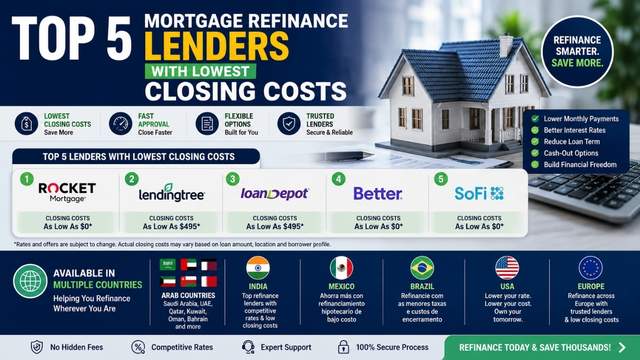
While interest rates often get the most attention, the “break-even point”—the time it takes for your monthly savings to cover the cost of the loan—is determined by what you pay at the closing table. Here are five lenders known for competitive fees and transparent pricing across major global markets.
Top 5 Mortgage Refinance Lenders with Lowest Closing Costs
1. Better.com (USA & Global Outreach)
Better has changed the digital mortgage landscape by eliminating lender fees. They do not charge commission or origination fees, which are often the largest components of closing costs. Their platform is entirely digital, making them a go-to for borrowers in the US, but their model is frequently studied and mimicked by fintech startups in Europe and India.
Why it ranks:
- No Origination Fees: You won’t see a “processing” or “underwriting” fee on your Loan Estimate.
- Transparency: You can see real-time rates and fee breakdowns without a hard credit pull.
- Speed: Their automated system can sometimes provide a commitment letter in minutes.
2. Rocket Mortgage (USA, Mexico & Brazil Influence)
Rocket Mortgage is the largest retail lender in the US and has a significant influence on how digital lending works in the Americas. While they do have fees, their scale allows them to offer “No-Closing-Cost” refinance options. In these cases, the lender covers the upfront costs in exchange for a slightly higher interest rate.
Why it ranks:
- Flexibility: Great for borrowers who want to keep cash in their pockets today.
- Technology: Their app-based interface is the gold standard for tracking documents in Mexico and Brazil’s emerging digital markets.
- Custom Terms: You can choose your own loan term (e.g., an 18-year mortgage) to match your financial goals.
3. HSBC (India, Europe, and Arab Countries)
HSBC is a powerhouse for international borrowers, especially in India, the UAE, and across Europe. They offer “Premier” banking benefits that often include waived or discounted application fees for existing customers. Their global presence makes them ideal for expats or individuals with income in multiple currencies.
Why it ranks:
- Relationship Discounts: If you hold an account with them in Mumbai, Dubai, or London, you often get a lower rate and reduced fees.
- Global Portability: They understand international credit profiles better than local banks.
- Competitive Fixed Rates: Particularly strong in the UK and UAE markets.
4. HDFC Bank (India)
For the Indian market, HDFC remains a leader in home loan refinancing (Balance Transfers). They offer some of the lowest processing fees in the region, often capped at a flat amount rather than a high percentage of the loan.
Why it ranks:
- Low Processing Fees: Frequently run “monsoon” or “festive” offers where processing fees are waived.
- Hidden Cost Transparency: They provide a clear list of legal and technical appraisal charges upfront.
- Doorstep Service: A human-centric approach that still dominates the Indian mortgage market.
5. Caixa Econômica Federal (Brazil)
In Brazil, Caixa is the dominant force. For refinancing or “Portabilidade de Crédito,” they offer rates that are hard for private banks to beat. Their closing costs are regulated and often lower for mid-to-low-income borrowers.
Why it ranks:
- Government Backing: Lower interest margins compared to private Brazilian banks.
- Social Programs: Integration with housing programs that reduce administrative fees.
- Wide Access: Accessible in almost every municipality in Brazil.
Cost Comparison by Region
Closing costs vary wildly based on local taxes and regulations. For example, in the USA, you might pay for title insurance, while in India, stamp duty is the primary concern.
| Region | Typical Closing Costs (%) | Key Cost Drivers |
| USA | 2% – 5% | Title insurance, Origination, Appraisal |
| India | 0.5% – 2% | Stamp duty, MODT, Processing fees |
| Europe (UK/Ger) | 1% – 4% | Solicitor fees, Land Registry, Product fees |
| Arab Countries (UAE) | 1% – 3% | Valuation fees, Trustee fees, Bank processing |
| Brazil/Mexico | 2% – 6% | Notary fees, Registration, ITBI tax |
Fee Breakdown: What Are You Actually Paying For?
When you receive a loan estimate, the costs are usually split into “Lender Charges” and “Third-Party Charges.” You can only negotiate the lender charges.
- Origination/Processing Fee: This is what the bank charges to evaluate your loan. Some lenders charge 1%, while others charge a flat fee of $1,000 or 50,000 INR.
- Appraisal Fee: A professional must verify the value of your home. This is almost always a third-party cost.
- Title/Legal Fees: These ensure the property is legally yours and the lender’s lien is recorded. In the Middle East and Latin America, notary fees make up a large portion of this.
- Prepaid Items: This includes property taxes and homeowners insurance that you pay into an escrow account.
How to Reduce Your Closing Costs
You don’t have to accept the first offer you receive. Use these strategies to lower your out-of-pocket expenses:
- Comparison Shop: Get at least three Loan Estimates. Lenders will often match a competitor’s lower origination fee to win your business.
- Ask for a Credit: Some lenders offer a “Lender Credit.” They pay your closing costs, and in exchange, your interest rate might be 0.25% higher. This is smart if you plan to sell the house in 3–5 years.
- Negotiate Add-on Fees: Look for “junk fees” like courier fees, administrative fees, or application fees. Ask the loan officer to waive them.
- Use Local Lenders: In India or Mexico, local credit unions or smaller banks might have lower overhead and charge less for processing.
The “No-Cost” Refinance Myth
A “no-cost” refinance isn’t actually free. The lender either rolls the costs into your total loan balance (meaning you pay interest on your closing costs for 30 years) or raises your interest rate.
Example Comparison:
- Standard Refi: 6.0% Interest + $5,000 upfront fees.
- No-Cost Refi: 6.5% Interest + $0 upfront fees.
If you stay in the home for 10 years, the 6.0% rate is much cheaper. If you plan to move in 2 years, the 6.5% rate is better because you didn’t waste $5,000 on a house you’re leaving.
Market-Specific Advice
- In the Arab Region (UAE/Saudi Arabia): Focus on “Exit Fees” from your current bank. Some banks charge 1% of the remaining balance to let you leave. Factor this into your closing costs.
- In India: Look for “Balance Transfer” schemes. Banks like ICICI and SBI often offer zero processing fees for customers with high CIBIL scores.
- In the USA: Pay attention to the “Section A” on your Loan Estimate. This is the only area where the lender has total control over the price.
- In Europe: Keep an eye on “Product Fees.” Many UK lenders charge a flat £999 or £1,499 fee regardless of the loan size.
Final Checklist Before You Sign
Before committing to a refinance, verify these three things:
- The Break-Even Point: Divide your total closing costs by your monthly savings. If it takes more than 36 months to break even and you might move, don’t do it.
- The Net Tangible Benefit: Will this refinance actually improve your life, or are you just moving debt around?
- The Fine Print: Check for prepayment penalties. These are common in some international markets and can bite you if you try to pay the loan off early.
Refinancing is a math problem, not a brand loyalty problem. Choose the lender that gives you the lowest “Total Cost over 5 Years,” not just the one with the lowest monthly payment.
Also Check:- Debt Consolidation vs Settlement: Which One Saves More Money?