
Settling debt requires more than just making minimum payments. It demands a tactical approach to how you allocate your cash flow. Whether you are dealing with credit cards in the US or personal loans in India, these five strategies focus on reducing the total amount you owe and shortening the time you spend in debt.
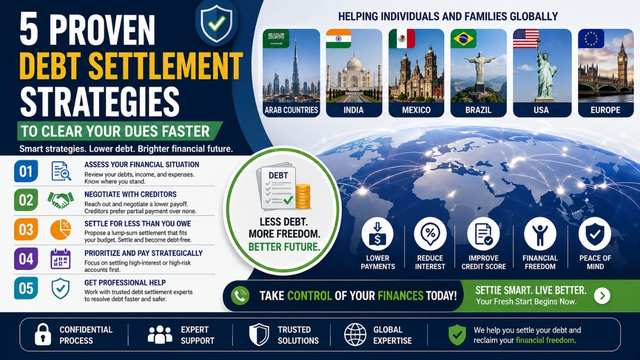
5 Proven Debt Settlement Strategies to Clear Your Dues Faster
1. The Debt Avalanche Method
The Debt Avalanche is mathematically the most efficient way to clear dues. You list all your debts and rank them by interest rate. You pay the minimum on everything except the debt with the highest interest rate. Every extra rupee, peso, or dollar goes toward that high-interest balance.
Once the most expensive debt is gone, you “avalanche” that entire payment into the next highest interest rate.
Example Comparison:
| Debt Type | Balance | Interest Rate | Strategy Priority |
| Credit Card A | $5,000 | 24% | 1 (Primary Target) |
| Personal Loan | $10,000 | 12% | 2 |
| Car Loan | $15,000 | 6% | 3 |
Why it works: You minimize the “cost of money.” By killing the 24% interest first, you stop the debt from compounding faster than you can pay it.
2. Strategic Lump-Sum Negotiation
Debt settlement involves negotiating with creditors to accept a one-time payment that is less than the total balance. This is common in the USA, India, and Brazil for accounts that are already 90+ days delinquent.
In India, this is often called a “One Time Settlement” (OTS). In the US, you might settle a $10,000 debt for $5,000 if you can prove financial hardship.
The Negotiation Process:
- Save the “Settlement Fund”: Stop making small payments and pool that money into a separate account.
- Wait for the Offer: Creditors often become more willing to negotiate as the debt ages.
- Get it in Writing: Never pay a settled amount without a letter stating the debt is “Settled in Full” or “Paid in Full.”
Warning: In many regions, including Europe and the US, a settlement will temporarily lower your credit score, but it removes the debt burden immediately.
3. Credit Card Balance Transfers (Low-Rate Arbitrage)
In markets like the USA, Europe, and parts of the Arab world (like the UAE), banks offer “0% APR Balance Transfer” cards. You move your high-interest debt to a new card that charges zero interest for 12 to 21 months.
The Calculation:
If you owe $6,000 at 20% interest, you pay roughly $100 a month just in interest. If you transfer that to a 0% card (even with a 3% transfer fee), every cent of your payment goes toward the principal.
Regional Availability:
- USA/UK/Europe: Widely available with high credit scores.
- India: Less common as “0%,” but low-interest EMI conversions are a similar alternative.
- Brazil/Mexico: Interest rates are often much higher; look for “Consolidation Loans” instead.
4. The Debt Snowball (Psychological Momentum)
While the Avalanche focuses on math, the Snowball focuses on behavior. You list debts from smallest balance to largest balance, regardless of interest rates. You pay off the smallest debt first to get a quick “win.”
This strategy is highly effective in Brazil and Mexico, where high inflation and complex interest structures can make debt feel overwhelming. Seeing a balance hit zero provides the dopamine hit needed to stay disciplined.
5. Debt Consolidation Loans
This involves taking one large loan at a lower interest rate to pay off multiple high-interest debts. This simplifies your life into one monthly payment.
In India, personal loans for debt consolidation are popular for clearing multiple “Buy Now Pay Later” (BNPL) dues. In Arab countries, “Salary Transfer Loans” often offer the lowest interest rates for debt consolidation because the bank has the security of your monthly paycheck.
Consolidation Benefits by Region:
- India: Consolidate multiple 36% interest credit card debts into one 13-15% personal loan.
- Brazil: Use “Crédito Consignado” (payroll-linked loans) which offer significantly lower rates than standard credit cards.
- Europe: Utilize low-interest personal loans to clear high-cost “overdraft” fees.
Global Debt Interest Context
Understanding the local environment helps you choose the right strategy.
| Region | Typical High-Interest Debt | Common Settlement Hurdle |
| USA | Credit Cards (18-29%) | High impact on credit scores. |
| India | Personal Loans / BNPL (15-40%) | Aggressive recovery agents. |
| Brazil | Rotativo (Credit Card) (up to 400%) | Mathematically impossible to pay via minimums. |
| Mexico | Tarjetas de Crédito (40-70%) | High variable rates. |
| Arab Countries | Personal Loans (4-8% Flat) | Legal implications for non-payment. |
| Europe | Overdrafts / Credit Cards (10-20%) | Strict consumer protection laws. |
Practical Steps to Start Today
- Audit Your Dues: Create a spreadsheet with every lender, the balance, the interest rate, and the minimum payment.
- Cut Non-Essential Spending: In every country, debt is cleared by increasing the “gap” between income and expenses. If you live in a high-inflation market like Brazil or India, this is your primary tool.
- Communicate: Call your bank before you miss a payment. In the USA and Europe, “Hardship Programs” can temporarily lower interest rates if you ask.
- Avoid New Debt: You cannot put out a fire while pouring gasoline on it. Freeze your credit cards (literally put them in ice) while executing these strategies.
Comparison of Outcomes
This table shows how much you save on a $10,000 (or equivalent local currency) debt at 20% interest with a $500 monthly payment.
| Strategy | Time to Pay Off | Interest Paid |
| Minimum Payments Only | 15+ Years | $12,000+ |
| Debt Snowball | 24 Months | $2,100 |
| Debt Avalanche | 22 Months | $1,850 |
| 0% Balance Transfer | 20 Months | $300 (Fee only) |
Final Thoughts
There is no “magic” fix for debt. The Avalanche is for those who want to save the most money. The Snowball is for those who need motivation. Settlement is for those who are in a crisis. Choose the one that fits your current cash flow and stick to it for at least six months to see real progress. Your goal is not just to be “debt-free,” but to stay debt-free by building an emergency fund once these dues are cleared.
Also Check:- Premium Credit Cards Compared: Best Perks for Frequent Flyers