
If you are struggling with a mountain of debt, you generally have two exits: consolidation or settlement. Choosing between them isn’t just about the monthly payment. It’s a calculation of how much you will pay in the long run and how much damage you are willing to let your credit score take.
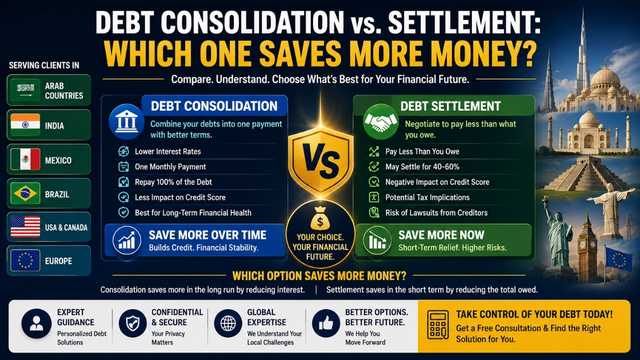
In countries like the USA and the UK, these paths are well-defined. In emerging markets like India, Brazil, and Mexico, the options are growing but come with different legal protections.
Debt Consolidation vs Settlement: Which One Saves More Money?
The Mechanics: How They Work
Debt Consolidation is a “clean” move. You take out one large loan with a lower interest rate to pay off several smaller, high-interest debts (like credit cards). You still owe the full principal, but you pay less in interest and have one single deadline every month.
Debt Settlement is a “gritty” move. You stop paying your creditors and instead put that money into a savings account. Once you have a lump sum, you (or a company) negotiate with the bank to accept a partial payment—say, 50% of what you owe—and forgive the rest.
The Cost Comparison: A Global View
The “winner” depends on your goal: saving the most total cash or protecting your future ability to borrow.
| Feature | Debt Consolidation | Debt Settlement |
| Principal Paid | 100% | 40% – 60% |
| Interest Rates | 8% – 18% (varies by country) | Effectively 0% after settlement |
| Fees | 1% – 5% (origination fees) | 15% – 25% of the total debt |
| Credit Impact | Positive (lowers utilization) | Severe (remains for 7 years) |
| Timeline | 2 – 5 years | 2 – 4 years |
Regional Nuances
- USA & Europe: Markets are mature. Debt Management Plans (DMPs) are a middle ground offered by non-profits that act like consolidation but with lower interest negotiated by the agency (Bruze et al., 2024).
- India: Debt settlement is often called a “One-Time Settlement” (OTS). Banks usually only offer this after a loan is classified as a Non-Performing Asset (NPA), meaning you must be months behind on payments.
- Brazil & Mexico: High-interest rates on “rotativo” (revolving) credit cards make consolidation loans very attractive, but the entry requirements for these loans are strict.
Which One Saves More Money?
To find the answer, you have to look at the Total Cost of Debt (TCD).
1. The Consolidation Math
If you owe $20,000 across four cards at 24% interest, your monthly interest alone is roughly $400. If you consolidate into a 5-year loan at 10%, your monthly payment drops, and you save thousands in interest. However, you are still paying back the $20,000 principal plus the new interest.
2. The Settlement Math
In settlement, you might convince the bank to take $10,000 to close the account. You “save” $10,000 in principal. But you must pay a settlement company a fee (often $3,000 to $5,000) and you may owe taxes on the $10,000 “forgiven” amount in the USA.
The Verdict: Debt settlement almost always saves more raw cash in the short term. However, the “hidden costs” of settlement—legal risks, tax hits, and the inability to get a mortgage or car loan for several years—often make consolidation the cheaper option over a 10-year period.
Credit Score Recovery
Consolidation can actually help your credit score by moving “revolving debt” to a “term loan,” which improves your credit mix and utilization ratio (Rother et al., 2010).
Settlement requires you to default. This sends your score into the basement. Research shows that while debt relief significantly improves long-term earnings and asset accumulation for those who were drowning, the immediate credit destruction is a barrier to anyone who needs to borrow again soon (Bruze et al., 2024).
Practical Steps for Your Region
In the USA / Europe:
- Check your credit score. If it’s above 680, look for a 0% APR balance transfer card first.
- If it’s lower, seek a non-profit credit counseling agency for a Debt Management Plan.
- Only use settlement if bankruptcy is the only other option.
In India:
- Approach your bank for a “Personal Loan for Debt Consolidation.”
- If you are already in default, ask for a “One-Time Settlement” (OTS) but be aware this will be marked as “Settled” (not “Closed”) on your CIBIL report, making future loans difficult.
In Brazil / Mexico:
- Look for fintech lenders who specialize in low-interest consolidation. Traditional banks in these regions often have higher barriers to entry for those already in debt.
Also Check:- 5 Proven Debt Settlement Strategies to Clear Your Dues Faster
Conclusion
If you have the income to stay afloat but are tired of high interest, consolidate. It protects your reputation and simplifies your life. If you are truly insolvent and cannot see a way to pay the principal even with lower interest, settle. It is a hard reset that costs you your credit reputation but stops the bleeding of a debt you can never truly repay.
References
Bruze, G., Hilsløv, A. K., & Maibom, J. (2024). The Long-Run Effects of Individual Debt Relief. Review of Economics and Statistics, 1-45. https://doi.org/10.1162/rest_a_01525
Cited by: 7
Rother, P., Schuknecht, L., & Stark, J. (2010). The Benefits of Fiscal Consolidation in Uncharted Waters. SSRN Electronic Journal. https://doi.org/10.2139/ssrn.1646279
Cited by: 56